Showing posts with label infrastructure goes bananas. Show all posts

12KUBE

To whom it may concern,

I am currently involved in the development of a project for an art-festival-rave-exhibition planned for an undisclosed point of time this future. The working title is 12KUBE, and the skinny is basically a setup for 12 separate exhibition spaces for 12 invited artists, all housed in a large venue yet to be defined.

In this process I'm looking into developing a scheme that is universal, site-unspecific, and incorporate ideas from our collective interest in emergent behaviour, game theory and to some extent perhaps situationism applied in architecture. The overall aim is primarily to investigate a spatial organization detached from traditional functionalist paradigms, with aims to establish an architecture that is inhabited or occupied rather than executed as part of program, meaning an effort to fertilize natural bottom-up emergant behavioural patterns.

This is of course a paradox, and this is where any discussion of such ideas begins. How to design a system of non-design? And isn't any large gathering of individuals inherently subject to emergent behaviour?

What follows is a series of initial sketches, outlining the basic premise.

For those not familiar with Conway's Game Of Life, here is some further reading hypertext:


What I find interesting in this approach is the potential of colliding organizational systems, the overall configuration of the space is generated by a simple set of rules. The collision as such comes into effect when human agents operate in the negative, left-over/in-between-space the first system dictates, and their own operational agendas as participants.

The interior of the cubes themselves will of course also play a large part, and attract or detract attention in relation with their content, and I assume various architectural or other attributes will become relevant, in particular use of light, sound, heat. I would propose to keep the main hall largely darkened, with potential to temporarily illuminate sections of the space to stage ephemeral, pop-up performance/eventspaces that in theory could occur at any place or at any time within the darkened space. These events could be utilized as catalysts to temporarily activate unpopular parts of the playing field effectively "breaking the fourth wall" by making the participants momentarily self-aware. To further underline the potentials of the concept, I would also propose eventual seating arrangements to be mobile, lightweight and singular, this importance made evident in this film (@20:20), which I also highly recommend watching in full.

There are different approaches to the kind of games Conway's "Game of Life" represents, if not only in terms of geometric similarities. A familiar example is the simple game of tic-tac-toe, as mentioned in the leda tutorial. Another example to some extent, the windows classic minesweeper. Another more prolific, the japanese game GO.

Below is a set of investigations I did during todays lecture on modern day virtue-ethics. Incidentally, the flipside provided me with the alternative tic-tac-toe approach, produced some months earlier at a similar event.


The rules I experimented with included the following: Each cube may create clusters, but no larger than three in size. Clusters may join orthogonally or diagonally, with a maximum length of two cubes orthogonally, and three diagonally. Spacing between clusters are related to their size, a cluster of two may not be in closer proximity to another cluster than two cubes, singles may be positioned within a single cube's distance. This complicated exercise in parametric design was performed using a supercomputer.

The alternative tic-tac-toe exercise followed standard championship rules. X vs O, five in a row wins and ends the game.


That is all for now. Any feedback is appreciated. The project is a collaboration with and the brain-child of Michael Hare.

The Aesthetics of Dust - The bigger picture


So, all of a sudden one of SPS's ongoing researchs, The Aesthetics of Dust, is linked to the agenda of the day. As all airports in northen Europe are being shut down, The Aesthetics of Dust announces its presence and it is overwhelming.


I stumbled upon this picture (below) from 9/11, which clearly reveals the dimension of fear, rage and violence connected to dust clowds. At the same time, this picture clearly manifestate the spatial potential of the dust. Maybe it is time to reverse this idea of the dust clowd as something frightening and threatful.


Ladies and Gentlemen, I think it is time to construct and inhabit the friendly dust cloud. And with those words, this blogpost is passed on to Bas Jan Ader's Tea Party (1972):


snow-free urbanity


"snö"
brooklyn, new york city. pen on paper. Magnus Ohren 14-feb-2007.

Excerpt from "The world without us" by Alan Weisman
"Dr. Eric Sanderson sees water flowing everywhere in town, much of it bubbling from underground ("which is how Spring Street got its name"). He's identifed more than 40 brooks and streams that traversed what was once a hilly, rocky island in the Algonquin tongue of its first human occupants, the Lenni Lenape, Manhattana referred to those now-vanished hills. When New York's 19th-century planners imposed a grid on everything north of Greenwich Village - the jumble of original streets to the south being impossible to unsnarl - they behaved as if topography were irrelevant. (...)

Later, new contours arose, this time routed through rectilinear forms and hard angles, much as the water that once scuplted the island's land was now forced underground through a lattice of pipes. Eric Sanderson's Mannahatta Project has plotted how closely the modern sewer system follows the old watercourses, although man-made sewer lines can't wick away runoff as efficiently as nature. In a city that buried its rivers, he observes, "rain still falls. It has to go somewhere."

Lets not deny this fact. Snow and our 19th-century urban fabric does not melt together well.

Last year in Oslo public cries has been put forth to dump excess snow into the ocean, possibly without concern for the logistically failed idea of dumptrucks filled with snow clogging up already soaked infrastructure. On the other side of the globe the Chinese are using traditional methods of firework deployment to eliminate snow before it reaches the ground.

With new urban development being planned in snow-filled urban regions the world over, I ponder this question; has anyone ever considered attacking the problem where the snow actually falls?

This constitutes new concepts of urban development. Imagine infrastructure intergrated into new urban development, using low or high-tech methods. Melting the snow instantly as it falls with an intergrated pavement heating system is a tempting solution, but no. It is stupid.

Consider this: In the developed urban fabric, intergrate cavities for snow processing. In this controlled environment, snow can be dealt with in a proper manner. Lets not forget that this very snow is now no-longer romantic white and light-reflecting, but turned brown with exhaust and other human residues, soaked by arrays of kidults' dirty wet sneakers and old ladies fighting for their very lives, dragged into local bar-cafés, bookstores and conventient-stores making urban life unbearable for more or less anyone who has any concept of "the good life" in the city.

Our lazy sundays ruined just by thinking of stepping out the doorway.

These horrors aside, let's not forget that snow is water and water is a resource not to be messed with. I leave it to the crowd to ponder what glorious potential an underground waterpool can be used for. First impulse: pumped in tubes throughout the 4-5-6 story housing unit, heating the now care-free inhabitants in winter-hiatus. Anyone want to go out for a nice cup of cocoa? Imma put on my nikes. Lets just do it. Winter boot sales plummet. Clubs are packed with chicks in high heels. International logistic services celebrate.

To sum up; what the hell are we waiting for?

Sketch: Magnus Ohren, Oslo 27-feb-2010


Photo: Magnus Ohren, Oslo 28-feb-2010


Mer infrastruktur!

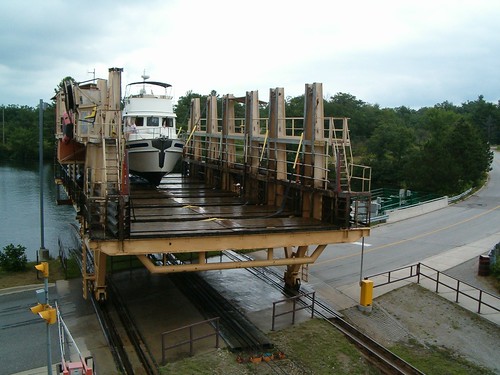
"Big Chute Marine Railway is a ship lift at Lock 44 of the Trent-Severn Waterway in Ontario, Canada. It works on an inclined plane to carry boats in a cradle (without a filled tank) over a change of height of about 18 metres. It is the only marine railway of its kind in North America still in use, and is overseen by federally operated Parks Canada."


Jojagtackarja! Marin järnbane. Det får mig direkt at tänke på min absolute drömmeferie: Dressin!


Er det i sommer det kommer til at ske?

"Draisine is spelled dressin in Sweden and dresin in Norway and dræsine in Denmark. In Finland the word is "resiina". Usually, dressin refers to pedal-powered rail-cycles which were used by railroad maintenance workers in Finland, Sweden and Norway until about 1950, as handcars were elsewhere.

Now dressins are used for recreation on several unused raillines in Germany, Sweden, Norway, Poland and some other European countries. There are several companies renting dressins in Sweden.

In Finland there has been annual competition "Resiina-ralli" (translates "Draisine Rally"), which involves several draisine teams traveling many days in the railroads from one corner of the country to another. The rally is televised and gathers great popularity among TV-viewers." -Wikipedia


Igår aftes var jeg ude og löbede i regnvejr. Meget dejligt. Indtil jeg löbede ind i en stolpe. Idag er jeg lidt forköled og har ondt i mit ben. Men det er ok. Imorgen skal jeg tegne plan og snit.