
Dear friends, family, rss-feeders and googlers of The South Pole Station,
The collaborators of South Pole Station is currently deeply engaged in projects outside of the SPS-realm. However, we will be back in the south on the other side of the summer solstice. In the meantime, please enjoy our link collection on your right hand side (after scroling down a bit) or check out the video clip below, a portait of Mark Allen and the inspiring Machine Project.
Showing posts with label why references ?. Show all posts
Showing posts with label why references ?. Show all posts

THE «YES» SESSION

Attended by three directors (Fritz Freleng, Bob McKimson and me), three writers (Warren Foster, Todd Pierce, and Mike), and the production chief (Johnny Burton), and – often, sadly – the producer. (The layout men did not ordinarily attend the jam session. It was felt best to bring them in on completion of the storyboard, coincidentally working with the director as he does the character layouts.)
This session was, I believe, an event unique to Warner Bros. Unique at that time, perhaps anytime. Because this was not a brainstorming session in the usual sense, it was a «yes» session, not an «anything goes» session. Anything went, but only if it was positive, supportive, and affirmative to the premise. No negatives were allowed. If you could not contribue, you kept quiet. For want of a better term, I have always called it THE «YES» SESSION. Again, the «yes» session is not a brainstorming session: repeat, it is not a session in which anything goes. The purpose is to advance an idea or ideas, not an emotional outburst for the emotional benefit of the participants or as a story man's confession of a buried affair with a girl's track shoe. The «yes» session only has one objective: to write a story.
The «yes» session imposes only one dicipline: the abolition of the word «no». Anyone can say «no». It is the first word a child learns and often the first word he speaks. It is a cheap word because it requires no explanation, and many men and women have acquired a reputation for intelligence who know only this word and have used it in place of thought on every occasion. The «yes» session lasts only for two hours, but a person who can only say «no» finds it an eternity. Negative-minded people have been known to finally inflate and burst with accumulated negatives and say something positive, because it is also true that a person who here-to-fore can only say «no» is also a person who must say something.
A «no» is defined as any negative: «I don't like it.» «There must be a better way.» «I don't like to criticise, but ... » «I've heard that one before.» «I don't know.» Or: «Oh, for Christ's sake, Chuck.» All are roadblocks impending the advancement and exploration of the value of an idea and are forbidden.
Of course, all story ideas are not good or useful, and if you find you cannot contribute, then silence is proper, but it is surprising how meaty and muscular a little old stringy «yes» (which is another name for a premise) can become in as little as fifteen or twenty minutes, when everyone present unreservedly commits his immedate impulse and positive response to it.
Excerpt from «Chuck Amuck: The autobiography of Chuck Jones»


2-way Computerless email system
South Pole Station has during the last six months worked on how to create a post-digital autoarchiving system of fluxing ideas. It's been a struggle with many up's and down's but we hope to have the system up and running by Summer 2011. In the meantime we decided it was time to look around to see what other similar technologies, working in the intersection of analog and digital communication, that is 'out there'. Let me introduce Celery:
Celery is offering a 2-way Computerless email system that let you exchange Email without a Computer or Internet Access!
* Easy to Use System
* Works with Any Fax
* Internet Not Required
* Caring Support Staff
Celery is also offering Fax to twitter / Twitter to fax!
Celery is offering a 2-way Computerless email system that let you exchange Email without a Computer or Internet Access!
* Easy to Use System
* Works with Any Fax
* Internet Not Required
* Caring Support Staff
Celery is also offering Fax to twitter / Twitter to fax!
Holy Wols - Porch Tour!

Holy Wols is David Feil and Amye McCarther, a Houston based Americana Duo that recently did a porch tour that caught my attention. I decided to do a small interview with Amye McCarther, not so much about the actual music, rather about the tour itself.
JI: Tell us a little bit about the porch tour, to start with, how did you come up with the idea?
AM: The idea came about organically. I think we were playing on our friend Zach's big porch over in Harrisburg and trying to plot a tour for the summer. The fact that we'd rather be playing on porches for our friends and neighbors than in venues for audiences occurred to us kind of simultaneously, I think. It made perfect sense because much of our music has actually emerged from lazy afternoons fiddling around on the stoop at David's or on the shady balcony at my house. So we started hitting people up for porches to play on, promising to croon and swoon and stomp our feet if they obliged.

This triggers my fascination for logistics! How was the tour organized?
Haphazardly. At first we were thinking that our porch tour would span our three favorite neighborhoods in Houston: Harrisburg, the Montrose, and the Heights. We secured a day to play at our friends' bookstore in the Heights on a Saturday evening. It has a quiet little back porch and we thought it would make a nice close to the day. Somehow neighborhood gossip and drunk talk carried fast and we had people asking if we would play on their porches - all of whom were in the Heights as well. So we narrowed our territory and planned a route for the afternoon of five porches from the northwest corner to the southeast.
What is the Heights like? And is there a 'scene' that you are a part of in Houston?
The Heights also has the tag "Historic Heights" and "The Small Town Near Downtown". It flanks downtown Houston and Buffalo Bayou to the northwest. Being an older neighborhood it sports two of my favorite things: huge old trees and grand verandas. The houses were built before the advent of air conditioning and in their day the verandas provided a shady breezy retreat from the stifling boggy heat which engulfs the city for about six months out of the year. Unfortunately, Houston's relaxed zoning and a recent trend of gentrification in the Heights has allowed many of these elegant older homes to be supplanted by newer, more chic looking structures sans verandas. Nevertheless, the Heights is the best remaining neighborhood for porches in the Houston area.
Despite the recent changes, the Heights still feels homey and cozy. It's become the place where young people go to try on domesticity for the first time, buy their first house, walk their dogs. And, like just about everywhere else in Houston, the warmth and damp make everything seem drowsy, the pace of life feels slow.
No, there isn't a scene that I'm part of in Houston. Or, rather, I'm part of many scene fragments. Chalk it up to sprawl, one of the fastest growing populations in the US, the dying off of independent music venues, etc. It really feels like you're operating in a vacuum here. Most musicians and artists eventually leave for that reason.
Were all gigs (is that word still used by the way?) the same day? Did you carry instruments with you? Was it just you and David that was biking between the porches or did parts of the audience follow you?
Yes, the gigs were all in one day.
As it happened we had a surprise guest that day, our friend Frank Davis. Frank is a sort of venerable, fun-loving folk/blues singer who has been performing in Houston since the 1950's. We went by Frank's on our way to the first porch and he asked if he could bring along his Daddy Banjo. We were delighted.
It was mostly the audience on bikes. David and Frank shuttled the instruments in the car. I rode on the back of my friend's bike. As we went from porch to porch more people came along, kids came out on their scooters, neighbors drifted over from other porches.
Our hosts were awesome. Everywhere we played they had barbeque, gin fizzes, lavender lemonade, and lemon bars. As the afternoon progressed everyone gradually got a little more boozy, the foot-stomping and whistling got a little boisterous. Good times.

Was it unplugged? Did you play the same set on all porches?
Yep, we played unplugged. David, Frank and I played on the porches and everyone else spread blankets under the trees in the yard to listen. We had already planned to play five different sets without repeating any songs. With Frank thrown into the mix it turned into a song swap. We sang on his songs, he sang on ours, someone would play solo while the others took a break for drinks and snacks. It was very relaxed.
Did the porches and the settings of the tour in general influence the performances? If yes, in which ways?
I think the music itself was, from its conception, influenced by porches. Also, I like things that have a conciseness or containedness about them and I think the porch tour achieved that. We wrote our lazy ballads on our own porches and then performed in the same fashion. The Southern hospitality, the temperate weather and good company knit together to create a sort of utopian atmosphere which we couldn't have made elsewhere. So, yes, I think porches were integral to the experience.

Holy Wols is touring in Texas, Arizona and California this summer. Listen to their tunes at holywols.com. Photos above by Andrew Lienhard and Oopey Mason.

What would Buckminster Fuller have done?
I was just stroke by a feeling that the World Expo 2010 in Shanghai is more a monument of our time, than speculations of future scenarios.
Looking back at the history of World Expo's, I have a feeling that the future as something exiting, something approaching and something desirable.
Now in the year 2010, we are living the future, over 50% of the world's population live in urban areas, blah, blah, blah. City bikes, blah, blah and blah. We know.
To quote Håkan Hellström; "Give me somthing to build a dream upon".

US Pavilion for the 1967 Expo in Montreal . (Courtesy the Estate of R. Buckminster Fuller)
Looking back at the history of World Expo's, I have a feeling that the future as something exiting, something approaching and something desirable.
Now in the year 2010, we are living the future, over 50% of the world's population live in urban areas, blah, blah, blah. City bikes, blah, blah and blah. We know.
To quote Håkan Hellström; "Give me somthing to build a dream upon".

US Pavilion for the 1967 Expo in Montreal . (Courtesy the Estate of R. Buckminster Fuller)
I never understood that it could be experienced
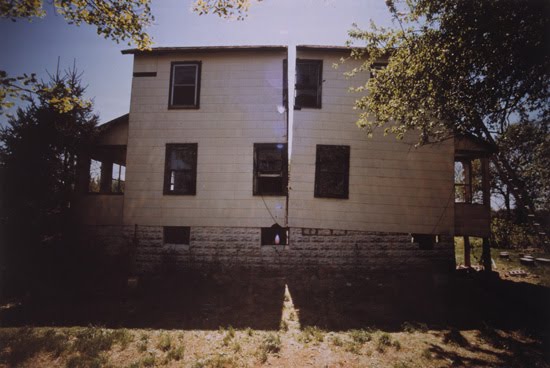
Idag er sket noget märkeligt og også helt fantastiskt. Jeg kom i snak med en dame, som väret i Gordon Matta Clark's vennekreds. Da hon sa noget i stil med at "dessvärre er det jo ikke nogle af hans verker der er bevarede" var det noget der gik op för mig. Det har jo, om en i et meget begrenset tidsrum, väret muligt at opleve hans verker. Da jeg har oplevet de kun gennem böger og andre representationsformer, har jeg opfattet det jeg oplevede derigennem som verket, og ikke som nogen representation.
Jeg kan märke hvordan verden ekspanderer i mit sind.
The Aesthetics of Dust - The bigger picture

So, all of a sudden one of SPS's ongoing researchs, The Aesthetics of Dust, is linked to the agenda of the day. As all airports in northen Europe are being shut down, The Aesthetics of Dust announces its presence and it is overwhelming.

I stumbled upon this picture (below) from 9/11, which clearly reveals the dimension of fear, rage and violence connected to dust clowds. At the same time, this picture clearly manifestate the spatial potential of the dust. Maybe it is time to reverse this idea of the dust clowd as something frightening and threatful.

Ladies and Gentlemen, I think it is time to construct and inhabit the friendly dust cloud. And with those words, this blogpost is passed on to Bas Jan Ader's Tea Party (1972):


Preface by the unknown copyist

"as I walked along the seastrand, I saw a shining object cast upon the beach by the high tide [...], the object spekled mysteriously, that which greed could not do was done by curiosity, and I descended, wading kneep-deep into the water, and I snatched it up. At first glance, it was just a common bottle of fine glass, carefully sealed with pitch. Immediately I called my driver and rode home. That evening, in the privacy of my study, I broke the bottle. Inside was a scroll of paper, the manuscript of Captain Adam Queensdale, deted 23 October 1761.
Although it had been well protected, over one hundred and twenty-five years the bottle had been carried by the ocean currents, the paper had suffered a degree of damage. I spent several exciting evenings copying the contents of the original which threatened to dintegrate into dust and ashes at any moment. The text contained a description of a shipwreck that only Captain Queensdale had survived; a description of the island, Ultima Thule, north of Iceland, where the castaway was taken in by the inhabitants, members of the heretical secto of Two-Wheelers, exiled from Europe in the 14th century: a description of life and rituals of the inhabitants, of their mythology and eschatology; abd at the end, a copy of the wholy text, The Purgatory of Sleep, the greater part of which, unfortunately, was so heavily damaged as the be unreadable.
Studying this tale, which had a healing effect on my sould, I decided to save it from oblivion, but also from the curiosity of the masses, from the quasi-scholars and sensationalists. The only way to do that was to act just as the bottle had acted toward me: I hade to let the story find its readers by itself. I made six completely identical copies and inserted them into six expensice, but uninteresting, books. I sent the boks to the addresses of reputable secondhand bookstores in London, Istanbul, Heidelberg, Reykjavik, Cairo and Bombay. They will. I am certain of it, know how to reach their readers. Everyone who comes to believe in their contents will do the same thing I did: he will make six copies of the text and find a way to release them into the world.
J. H. W.
4 July 1982"
Excerpt of "The Cyclist Conspiracy" by Svetislav Basara, 1988
Photo from Belgrade harbor, February 2010
So, what brings this text here? I read it last night in the book mentioned above and I felt directly how it connected to our ongoing investigations about detour communication, but also adding a layer of self-replication, an almost biomorphic approach, but still so low-tech and poetic.
Does here always has to be somewhere else?


Springdigging 16th of March 2010.
It is arrogant to think that things just appear, that it is something that just comes natural with time.
SEBASTIAN MAROT - LECTURE AT SPS
After a long time i found the famous Sebastian Marot lecture - 'EXILE ON MAIN STREET' on a video podcast at www.architecturaltheory.eu
 GORDON MATTA CLARK, WINDOW SHOOTING, NYC
"I didn't sleep this night because the guys in the airport wouldn't let me."
THE
NEXT
THING
I
remember is a 2.5 hours long lecture, traveling though the history of architecture as if he was just in the mood for it and didn't care about sleep at all.
{Lecture held at Symposium Landscape Fictions based on True Stories in aut (architektur und tirol), Innsbruck at October 24. 2008}
 GORDON MATTA CLARK, WINDOW SHOOTING, NYC
Some will remember Sebastian Marot from his lecture at Århus 2008 - I remember his first words;
THE
NEXT
THING
I
remember is a 2.5 hours long lecture, traveling though the history of architecture as if he was just in the mood for it and didn't care about sleep at all.
{Lecture held at Symposium Landscape Fictions based on True Stories in aut (architektur und tirol), Innsbruck at October 24. 2008}

tips and nominations
"Arg Dot Org"
 Behind the slightly cryptical adress http://a.aaaarg.org/ [Arg Dot Org] is a really nice theoretical .pdf archive hiding. Many text that I've had a hard time to find in libraries and on other online sources has been available there. One good feature is that you are able to compile an "issue" of different text and share it with other. For example for a workshop or studio. Its really worth checking out! (Nominated by JI)
#
"WFMU"
 Liz Berg choosing from the huge WFMU archive
Photo: Nicole Bengiveno/The New York Times
The New Jewsey freeform radio station WFMU, is nominated for it's 51 years of 'free form' radio activity, giving completely independence to the DJs - which can be extremely dangerous, but in this case turns out as brilliant inspiration. Furthermore we would like to recommend WFMU for it's preciseness and niceness.
...and as they say: ' We'll Never Leave Your Cake Out In The Rain." (nominated by AKN)
www.wfmu.org
doc alliance films
Hvis alle blogs handlede om at referere andre blogs, ville man efter utrolig lang tid kunne læse det samme på alle blogs. Det tror jeg ikke er fremtiden. Men alligevel er det blevet tid til at referere, gøre opmærksom på en reference, inden for internettes vidt udstrakte rammer. Ikke for at udvande THE WEB, men for at hylde neuronerne der limer vores verden sammen - og så fordi denne hjemmeside ikke er en blog, men en utrolig god idé - hvilket i sig selv er en reference værd...
...og så er vi tilbage ved starten af denne tråd - og det er et sted ingen af os har lyst til at være igen...
Se dokumentarfilm fra billigt til gratis!
www.docalliancefilms.com
tekst: Anders Krogdal
Idé: docalliancefilms
Subscribe to:
Posts (Atom)


 Posts
Posts


